
- Two Intel E5-2670 processors running at 2.6 GHz with Intel Turbo Boost and NUMA support.
- 244 GiB of RAM.
- Two 120 GB SSD for instance storage.
- 10 Gigabit networking with support for Cluster Placement Groups.
- HVM virtualization only.
- Support for EBS-backed AMIs only.
Pricing starts at $3.50 per hour for Linux instances and $3.831 for Windows instances, both in US East (Northern Virginia). One year and three year Reserved Instances and Spot Instances are also available.
High-Memory Cluster On-Demand Instances
Eight Extra Large $3.500 per Hour
High-Memory Cluster Reserved Instances
Eight Extra Large $2474 - $1.54 per Hour (1 year) - $3846 - $1.225 per Hour (3 years)
This looks pretty much like a typical High-End server I would buy for a high-performance application – or an ESXi Host.
Let us take those numbers for a minute and translate them to something that we actually can use.
On Demand – $3.5 x 24 (hours) x 365 (days per year) = $30,660
Reserved – $2,474 + $1.54 x 24 (hours) x 365 (days per year) = $15,964.40 (1 year)
Reserved – $3,846 + $1.225 x 24 (hours) x 365 (days per year) x 3 (years) = $36,039 (3 years)
Firstly – it is obvious that the Reserved instances are so much cheaper than their On-Demand counterparts – so proper planning can save a whole lot of money on AWS. I assume the serious AWS users will use Reserved instances.
(****** of course this does not take into account everything else like IP addresses, IN/OUT data transfer, monitoring, etc. ******)
I checked what a similar hardware spec would cost for BYOS (Buy Your Own Server) 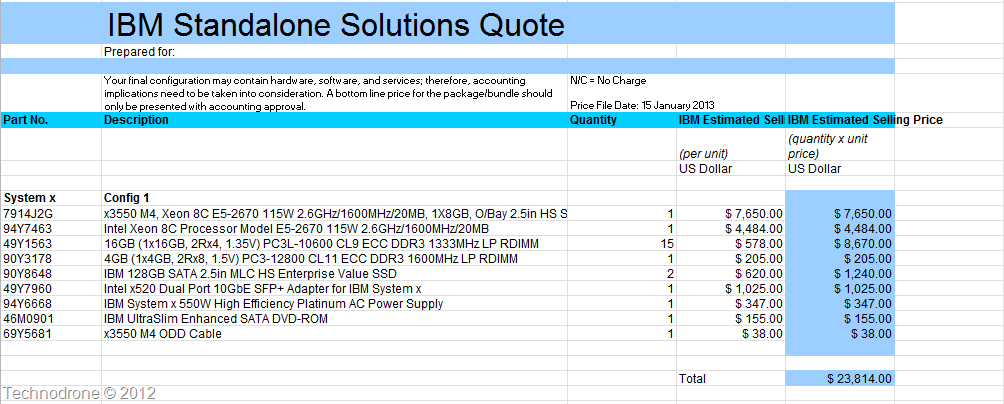
The price was $23,814 – this was list price - including 3 years 24x7x4 on-site support. (No Enterprise actually pays list price – and a 30% discount would be more than reasonable (if not more) – which would bring the price to $16,670).
And to be completely fair convert this into per hour:
$16,670 / 3 (years) / 365 (days) / 24 (hours) = $0.634 (per hour)
I could not find many (reputable) hosting providers that were offering something similar to this configuration online so that I could not compare properly the cost of a such hardware as a Hosted Dedicated Server.
The price of the hardware is not the only cost involved of course, and there are other elements should be added in (some of them listed below):
- Lead-time
- Administration
- Setup & Installation
- Maintenance & administration (people)
- Power & Cooling
- Backup & DR
- Network
And also having the flexibility of not actually having to run such a machine 24x7 was not factored – but I do think it is safe to assume – that if you are going to actually need such an AWS instance – it will be highly utilized.
So I cannot say that BYOS is half the price – because of all of the above. It could be cheaper – but it also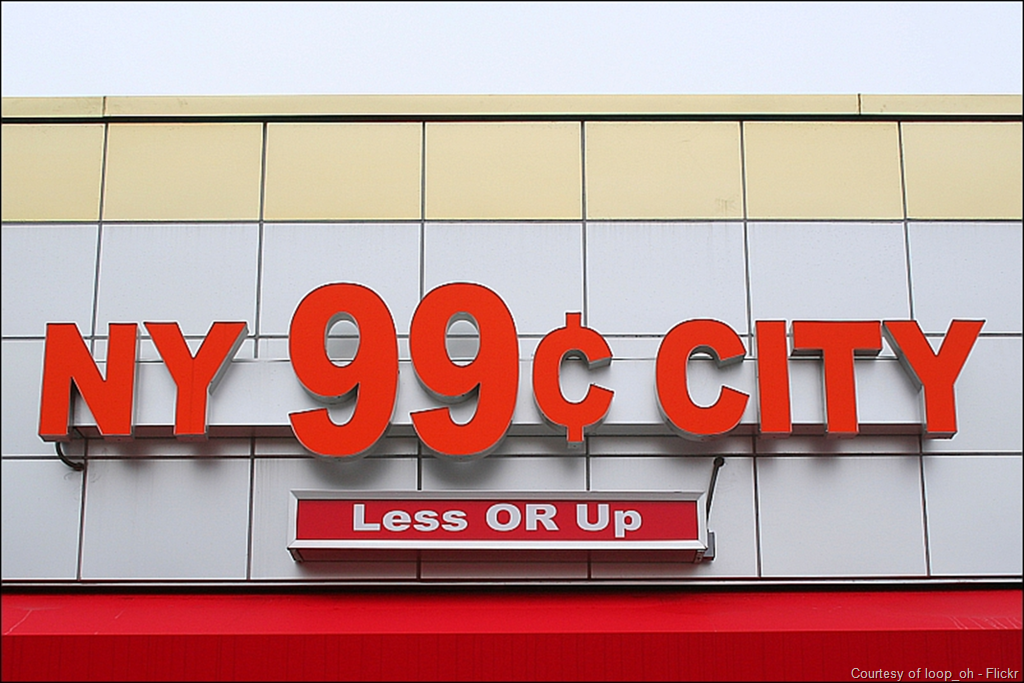
I can’t help feeling that this reminds me of the 99 cents marketing methods that stores use. It always seems cheaper than $1 and $1.54 does not really seem like a whole lot of money to spend per hour. But when you accumulate all those hours into days, weeks, months and years – it doesn’t look that bright and shiny any more.
(As a side note – I recently learned that one of our departments had spent approximately $500,000 on AWS in the past 18 months – which is not what they thought it would cost them when they started out)
We are (too much so – unfortunately) a consumer world, we buy things. Vendors know that – and try every trick in the book to get us to buy as much as they are able to sell. AWS sell cloud instances.
Just because things are there – and look like they are cheap does not necessarily mean that they always are.
To be honest – I think it would only be fair that AWS (or any cloud provider for that matter) should give prices not only per hour, but also per day and per month. This will be better for the consumer and easier for us to compare.
Crunch the numbers!
Comments and feedback are always welcome.