Showing posts with label Speaker. Show all posts

2017-08-01

Public Speaking - Like.. Y’know

<RANT /ON>

I was rubbed the wrong way today - listening to a podcast.

This is a podcast that I hold in high regard, the hosts are people I have had multiple conversations with over the years and they are well renowned and public speakers.

Like y'know

This is a problem with society as a whole so I will not name the podcast as to not single them out - but I will use them as an example.

The podcast was about a certain configuration management product and what they are doing in the cloud space.

The total running time of the podcast 32:00

I collected some metrics from the episode.

Host spoke 09:08 (9 minutes and eight seconds).
During that time the host used the word “Like” 36 times and the word “y’know” 36 times

Guest spoke 22:52 (22 minutes and 52 seconds)
During that time the guest used the word “Like” 64 times and the word “y’know” 153 times

Assuming that for occurrence it takes approximately 1 second - that totals to 489 seconds of worthless content of the episode (15% of the duration of the episode was wasted these words)

I grew up in South Africa so I am accustomed to the Queens English - and therefore use the Oxford dictionary as my source of truth.

This is the Oxford Dictionary definition of like (and I would like to emphasize this entry)

ADVERB

1 informal Used in speech as a meaningless filler or to signify the speaker's uncertainty about an expression just used.
‘there was this funny smell—sort of dusty like’

2 informal Used to convey a person's reported attitude or feelings in the form of direct speech (whether or not representing an actual quotation)
‘so she comes into the room and she's like ‘Where is everybody?’’

3 (like as/to) archaic In the manner of.
‘like as a ship with dreadful storm long tossed’

This is the Oxford Dictionary definition of you know

PHRASE

informal
1 Used to indicate that what is being referred to is known to or understood by the listener.
‘when in Rome, you know’
1.1 Used as a filler in conversation.
‘oh well, you know, I was wondering if you had any jobs for me’

Some of our generation (and almost certainly our kids generation) has forgotten how to speak - I know this is the case in English - and unfortunately - this has become a norm in Hebrew as well.

If you want people to take you seriously - then speak proper English. It does not make a difference if it on  podcast, at a presentation or even a customer call.

When was the last time you heard Steve Jobs, Donald Trump or Queen Elizabeth use “like, y’know”?

Every time you use these as filler words, a kitten dies, a unicorn loses some of its color, and we all become the slightest bit more and more stupid.

If you don’t have anything to say, then don’t. If you need to collect your thoughts - then do so - in silence. I promise you, no one will think any less of you - quite the contrary.

<RANT /OFF>
2015-05-17

Integrating OpenStack into your Jenkins workflow

This is a re-post of my interview with Jason Baker of opensource.com

Continuous integration and continuous delivery are changing the way software developers create and deploy software. For many developers, Jenkins is the go-to tool for making CI/CD happen. But how easy is it to integrate Jenkins with your OpenStack cloud platform?

Meet Maish Saidel-Keesing. Maish is a platform architect for Cisco in Israel focused on making OpenStack serve as a platform upon which video services can be deployed. He works to integrate a number of complementary solutions with the default out-of-the-box OpenStack project and to adapt Cisco's projects to have a viable cloud deployment model.

At OpenStack Summit in Vancouver next week, Maish is giving a talk called: The Jenkins Plugin for OpenStack: Simple and Painless CI/CD. I caught up with Maish to learn a little more about his talk, continous integration, and where OpenStack is headed.

Interview


Without giving too much away, what can attendees expect to learn from your talk?

The attendees will learn about the journey that we went through 6-12 months ago, when we looked at using OpenStack as our compute resource for the CI/CD pipeline for several of our products. I'll cover the challenges we faced, why other solutions were not suitable, and how we overcame these challenges with a Jenkins plugin that we developed for our purposes, which we are open sourcing to the community at the summit.

openstack_summit_logo

What affects has CI/CD had on the development of software in recent years?

I think that CI/CD has allowed software developers to provide a better product for their customers. In allowing them to continuously deploy and test their software, they can provide better code. In addition, it has brought the developers closer to the actual deployments in the field. In the past, there was a clear disconnect between the people writing the software and those who deployed and supported it at the customer.

How can a developer integrate OpenStack into their Jenkins workflow?

Using the plugin we developed it is very simple to integrate an OpenStack cloud as part of the resources that can be consumed in your Jenkins workflow. All the users will need is to provide a few parameters, such as endpoints, credentials, etc., and they will be able to start deploying to their OpenStack cloud.

How is the open source nature of this workflow an advantage for the organizations using it?

An open source project always has the benefit of having multiple people contributing and improving the code. It is always a good thing to have another view on a project with a fresh outlook. It improves the functionality, the quality and the overall experience for everyone.

Looking more broadly to the OpenStack Summit, what are you most excited about for Vancouver?

First and foremost, I look forward to networking with my peers. It is a vibrant and active community.

I would also like to see some tighter collaboration between the operators, the User Committee, the Technical Committee, and the projects themselves to understand what the needs are of those deploying and maintaining OpenStack in the field and to help them to achieve their goals.

One of the major themes I think we will see from this summit will be the spotlight on companies, organizations and others using the products. We'll see why they moved, and how OpenStack solves their problems. Scalability is no longer in question: scaling is a fact.

Where do you see OpenStack headed, in the Liberty release and beyond?

The community has undergone a big change in the last year, trying to define itself in a clearer way: what is OpenStack, and what it is not.

I hope that all involved continue to contribute, and that the projects focus more on features and problems that are fed to them from the field. It is fine line to define, and usually not a clear one, but something that OpenStack (and all those who consider themselves part of the OpenStack community) have to address and solve, together.

2015-05-11

Get Ready for the OpenStack Summit

The OpenStack community is converging on Vancouver next week for the bi-annual summit for all things OpenStack.

openstack_summit_logo

I am glad to be joining the event and I would like to share with you a short outline of what public events and activities I will participating in.

The rest of my time will be spread out over the Cross-Project workshops, the Ops sessions, other sessions and activities.

I am really looking forward to this event and please feel free to come and say hello.

2015-04-20

OpenStack Israel CFP Voting is Open

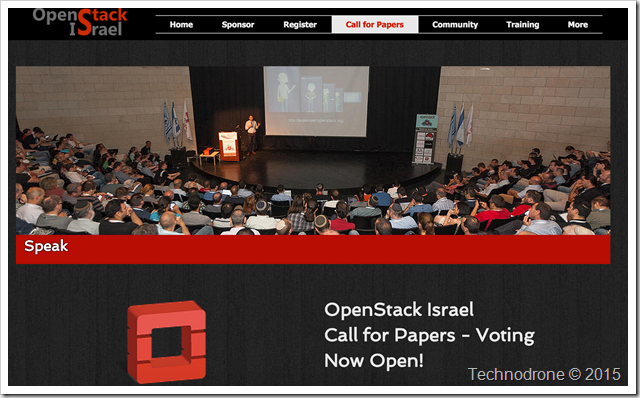
I would like to bring to your attention that the voting for the sessions for the upcoming OpenStack Israel Summit on June 15th, 2015 is now open.

Make your voice heard and participate in setting the agenda for the event!

image

You can find more information and the presentation that I gave last year in this post Recap - Openstack Israel 2014 #OpenStackIL and for your convenience I have embedded the recording below.

2015-01-12

Recording of DevOpsDays TLV 2014 Presentation

I would like to share with you the recording of the presentation I gave at DevOpsDays Israel – more information about the presentation can be found here.

It was interesting to hear the feedback from people – especially the developers, on how they do not know the other side of things. I think it was educational – and useful for all those who attended.

Presentation at DevOpsDays Tel Aviv 2014

The full presentation is embedded below as well

2014-11-23

Presenting - the Ignite way

Today I gave a presentation – actually two – but they were very different.

How many of you have heard about Ignite?

Ignite is the name for a particular type of event that is held throughout the world—organized by volunteers—at which participants speak about their ideas and personal or professional passions according to a specific format. The event holds the motto, “Enlighten us, but make it quick!” Anyone can throw an Ignite event. The presentations are meant to "ignite" the audience on a subject, whereby awareness, thought, and action are generated on the subjects presented.

Ignite is a presentation format that is shorter than the Pecha Kucha format, a presentation style in which 20 slides are shown for 20 seconds each, but longer than lightning talks, which are short presentations from five to 10 minutes in length. At an Ignite event, each speaker has a time limit of five minutes, and must use 20 slides with each slide advancing automatically after 15 seconds. This forces speakers to maintain a rapid pace. At a just-comprehensible clip of 160 words a minute, Ignite speakers can utter about 40 words per slide, making a total of 800 words for the complete talk.

Personally, I think this is one of the hardest methodologies to present.

You only have 15 seconds per slide – that means you need to get your point across in a very short time. Precise, and concise. The clock waits for no man

Visual slides are advised, it helps you get your point across. And bullet points should be kept to a minimum.

I thoroughly enjoyed doing this presentation. It took only five minutes – but preparation on the ideas, the delivery and content took over 2 hours.

A great challenge and something that I would totally do again.

Embedded below is the presentation (specifically in PPT format – since all the animations and timing are built into the presentation).


2014-11-20

Devs are from Mars, Ops are from Venus

I will be delivering a talk at the upcoming DevOpsDays Tel Aviv which will be on this coming Sunday and Monday.

devopdays banner

DevOps is one of my personal interests, especially educating of the other side of the table, the developers, as I do not see myself as one but rather an Operations kind of guy.

I will also be delivering an Ignite session about Using Social Media As a Tool in Your Daily Work.

I will be presenting with John Willis, Michael Ducy, Aviran Mordo, Sagy Rozman, Nir Cohen, Orit Yaron, Dror Bereznitsky, Eyal Edri and Oded Ramraz.

The full schedule is here.

Devs are from Mars

If you cannot join in person - the event is being streamed live and of course the presentations and recordings will be available after event as well.

Hope to see you next week – it will sure be interesting.

Live stream is embedded below

2014-08-06

OpenStack Paris Summit Session Voting

We are down to the wire – last two days to vote for the sessions you would like see at the upcoming OpenStack Summit in Paris.

image

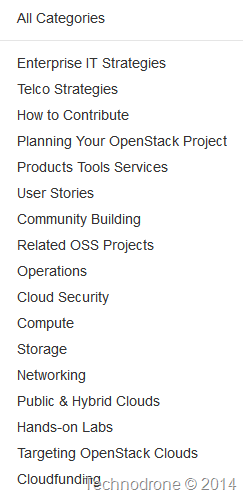
There are a large number of categories that you can choose from as you can see below:

categories

You will need an account to cast your vote.

It is quite interesting to see that some of the sessions are targeted at how you can migrate your workloads away from VMware and onto OpenStack, something that I think people will be looking into a lot more in the near future.

I also have a few sessions that you can cast your vote – if you so choose..

OpenStack Design Guide Panel

In July, 2014 The OpenStack Foundation brought twelve members of the OpenStack community together at VMware HQ in Palo Alto, California to produce the OpenStack Design Guide in just 5 days.  This panel brings many of these authors together for an open discussion about how to architecture an OpenStack cloud.

Bring your real-world questions and be prepared to talk OpenStack architecture with a panel of experts from across multiple disciplines and companies. We'll be drawing on real architecture and design problems taken from real-world experiences working with, and developing solutions, built on OpenStack. Following a brief introduction, panelists are ready to field questions from both the moderator and audience members and provide ongoing discussion the design process for architecting cloud solutions based on OpenStack.


Cisco's Media Solutions journey to the cloud with OpenStack

This session will go over how the Video Service provider group has added focus to deployment of its platform to support OpenStack. How this has evolved over the past year, the challenges that came up along the way and how these challenges were addressed - and solved.


Moving from a VMware Centric Architect to an OpenStack Architect

I have been designing VMware clouds and architectures for the past 4 years, and have now moved my focus to OpenStack. The change was not a simple one. There are terminology differences, architectural differences, differences in use cases. Differences in considerations regarding storage design, networking, automation, deployment - across almost every single aspect of the solution.

In this session you will learn what kind of change in mindset is needed, how to adapt to different architectural constraints, requirements and technical decisions.


Automated Deployment of OpenStack on Cisco UCS and Nexus

The Cisco OpenStack Installer provides automated deployment of OpenStack core components, as well as monitoring, storage, and high availability components. The release schedule of Cisco OSI parallels the community release. Where possible, Cisco OSI provides unmodified OpenStack code. Every new release of Cisco OSI follows the latest community stable release; however, in some cases Cisco might provide more recent patches that have been accepted into the OpenStack stable branches, but have not yet become part of an OpenStack stable release.

The Cisco OSI code update policy is to contribute code upstream to the OpenStack project and absorb patches into Cisco OpenStack Installer after they have been accepted upstream. Cisco deviates from this policy only when patches are unlikely to be reviewed and accepted upstream in time for a release or for a customer deadline (in such cases Cisco applies the patches to the repositories, submits them upstream, and replaces the local change with the upstream version when it is becomes accepted). Cisco also uses and contributes to modules from other upstream sources including Puppet Labs on StackForge.

In this hands on lab you will learn how to deploy OpenStack with the the Cisco OSI - knowledge that you will be able to take back with you to your organization and utilize for your own deployments.


Bringing Operators, Users and Developers closer together

This session proposal came as a result of a conversation on a blog post with Stefano Maffulli with regards to the acceptance of non-developers into the OpenStack world.

What tools are needed to interact with the developers - and the "developly challenged" people who are now starting to interact with wider OpenStack community. Because of the plethora of tools and the substantial on-ramp and learning curve in order to adapt - non-devs are finding it hard to contribute-voice their concerns or help.

This session will go over the tools used today, which tools should be used and when - and what we can expect in the future

Vote!

(source: https://www.flickr.com/photos/theresasthompson/2999130055/)

Remember – you are the one who decides what content you want to see – your vote counts!

2014-08-04

VMworld is 3 Weeks Away

Yep, that is 21 days. I do not think there is any need to introduce VMworld to the readers of my blog.

image

I would like to share with you some (and by no means a comprehensive list) of the activities I will be partaking in during VMworld.

Opening Acts 2014 — Panel Agenda - Sunday August 24th

I will be a panelist in the Architecture & Infrastructure Panel.

Opening Acts will be a series of group/panel discussions over the course of a few hours on Sunday afternoon. Whiteboards will be present, but no slides or PowerPoint.

It is an honor to give back something to the VMunderground crew!

vBrownbag – vExpert Daily Live Podcast – with Michael Letschin

I be on the live podcast on Monday and Wednesday morning at 10:30. This will be a live discussion about the announcements of the day, the vibe and what is happening at the show.

And last but not least my speaker debut at VMworld

Automating Host, Guest and Application Deployment in the Software Defined Datacenter with Cisco - NET3160-SPO

Automation is an essential component of the Software Defined Datacenter, without an automation solution this is destined for failure. We want to automate it all, from the deployment of the hardware, the hypervisor, the operating systems, and the application. This session will go through a customer story inside Cisco where an automation solution was implemented using PowerUCS, PowerCLI, Razor and Puppet to ensure a successful deployment from end to end. The session is technical, will provide a detailed architecture and methodology used in this customer, and how the solution reduced the deployment time from a number of days to a matter of hours.

You can expect a deep dive session here on Wednesday afternoon at 14:00-15:00. I will be one of only 4 Cisco sessions at the show with demos and some awesome integration between a great number of technologies.

vmworld2014

I can’t wait!

2014-07-21

Recording of my Presentation at OpenStack Israel 2014

Embedded below you can find the recording of my session
"OpenStack in the Enterprise - Are you Ready?"

You are welcome to go over the blog post I wrote about the event.

The full playlist of all the sessions can be viewed here

I have already submitted a few sessions for the upcoming summit in Paris.

2014-02-21

OpenStack Session Voting

I have submitted three different sessions for the upcoming Openstack Summit in Atlanta. This is the first time I have submitted content for an OpenStack Summit, and I am looking forward to attend the event.

I think the content of these sessions will be highly beneficial to all those who attend, and if you would like to hear some more about these topics at the Summit in May, I would appreciate your vote for one (or more) of the sessions.

Voting closes on Sunday, March 2nd, at 22:00 UTC.  You will need an OpenStack Community member account in order to vote.

OpenStack Summit Atlanta

Here are the three sessions I have proposed.

Deploying Redhat Openstack on UCS - Proposed Deployment Architecture

Deploying a robust OpenStack environment is critical in architectural design. If the foundation of your datacenter is not robust, redundant and scalable - you could encounter difficulties down the road.

In this session I will present a deployment architecture for OpenStack using Redhat OpenStack.

The topics covered in this session will include:

  • What are the benefits gained by deploying on UCS?
  • Why Control nodes should be deployed as virtual machines.
  • When should you deploy a OpenStack Role on bare metal only.
  • How the deployment with RHOS simplifies the process? (Foreman)
  • Scaling the architecture.


Takeaway

It is best to plan your deployment upfront and dedicate proper consideration to how your datacenter will look like in the future. The complications of issues arising when your infrastructure grows could be averted by proper planning and design.


UCS and Openstack - The Integration

Cloud is about abstraction of resources - compute, storage, and network, and when consuming resources in the public cloud - you, the customer don't really care about the physical resources.

But as an cloud administrator - that is a whole different story, especially when it is about your private cloud.

At Cisco we have been working on integrating the physical with the virtual - taking your operations to a whole new level.

During this session you will see the some of the work done to integrate UCS hardware - directly into the Horizon dashboard.

The benefits are substantial:

  • being able to control the virtual and the physical under a single interface
  • being able to access a KVM console of a specific compute nodes when disaster attacks
  • being able to dynamically assign more physical resources to your OpenStack cluster with absolute minimal overhead

That is the something every admin would like and Cisco is working to provide.

The session topics will include:

  • Plugin development
  • UCS API
  • Integration into OpenStack

Takeaway

OpenStack admins are looking for integration of the a full stack, virtual and physical. The UCS plugin for OpenStack provides that insight into the physical resources, reducing TCO for your OpenStack deployments.


Deploying the Openstack Management Layer - the undercloud

Most of us assume that the underlying OpenStack infrastructure is always in place, but there always comes a time where you have to actually put it there.

There are several ways of doing this. PackStack, KickStack, Cisco even have there own implementation - COI.

But how many servers should you deploy on? 

Can they be virtual or do they have to be physical machines?

What are the benefits/drawbacks of either of the above?

During this session I will go over the advantages of actually deploying the management infrastructure as virtual machines or in other words "the undercloud". 

There are several complications and implications when going down this route. 

  • How should you manage this environment?
  • What virtualization platform should you use?
  • Redundancy and high availability.

This talk will also touch on projects in incubation (i.e. Tuskar)

Takeaway

The management components are the most crucial in your OpenStack infrastructure. Learning how to deploy and protect them in an efficient way will assist you in providing the best service to your customers.

2013-12-16

0-Day Deployment - My Presentation at the #UKVMUG

A few weeks ago - I gave a session about how to deploy a full environment starting from a bare rack to a fully functioning environment with deployed applications.

Firstly about the VMUG event. I was fortunate enough to be invited by the VMUG organization to present at this years VMUG. I would like to extend my thanks to the VMUG organization for their hospitality and the effort they made to help feel at home (including kosher food)

There were approximately 400-500 people at the Event, the location was very nice and the the organization of the event was very well done.

The lineup of speakers, sponsors and vendors was very impressive, the local VMUG leaders and VMUG organization did an outstanding job.

Community was a big part of the event, just the way it should be.

I got to chat a bit with Joe Baguley, the VMware CTO, EMEA - about competition, "co-opetition" and what will happen in the future. We can never be prophets, but even if only half of what we talked about does actually come to be, then amazing things will happen.

I highly enjoyed the keynotes, both from Joe Baguley, and Greg Ferro - who surprised me with the amount of information he knows about ducks, and agriculture. They are both outstanding speakers.

Back to the session. Firstly I would like to thank the brave souls that attended my session. There were not many of you, because the slot I got was the same as three other VMware speaker sessions, one by Massimo Referre, the other by Cormac Hogan, and the last was a panel with Mike Laverick and Joe Baguley.

It not uncommon that one has to stand up an environment - of 8-50 hosts and 50-250 virtual machines. But is not quite common that you have to do this - when you have no existing infrastructure at all. This was the case I was presenting. Standing an infrastructure from complete zero to a fully deployed virtual VMware environment - in the most automated fashion possible.

There are a lot considerations that you have to take into account, for example - Autodeploy is more or less out of the question - seeing that you have no vCenter environment up and running yet.

How do you get vCenter up? How to deploy VM's? How do I configured the underlying storage array, the network switches, so many questions and dependencies.

The process is not ideal, not fully automated, but it will become so - not too far in the future.

In the meantime - here is the slide deck from my presentation.

Hope to see you all at another VMUG event soon!

2013-12-12

OpenStack Israel 2013 #OpenStackIL

This week at the OpenStack Israel conference there was a impressive turnout of approximately 400 people. It was a vibrant day, lots of interesting people from all over the world, and great sessions. I even got to have lunch with Scott Herold!

Here are some of the moments from day

I delivered a session "OpenStack for VMware Admins" going over the differences, similarities and some gotchas from those who are used to VMware environments, and are looking at OpenStack

And we're back with three stellar tracks @maishsk from @cisco on #openstack for #vmware admins #openstackil pic.twitter.com/Uv5cfDiK6V

Here are pictures from the day.


Created with flickr slideshow.

I think that the Israeli team did a great job, in attracting the talent to come to the conference. I was happy that I could present and am looking forward to seeing the recordings when they come online.

My session is available online and embedded below.