Showing posts with label Operations. Show all posts

2016-10-25

Pre-OpenStack Summit Post

I am on my way to the summit – cutting it fine, as I will only be arriving after the keynotes have started on Day 1. That is part of my life being a religious orthodox Jew.

Just a few hours ago, I finished the festival of Sukkot, a festival where we ‘leave’ our homes for 8 days and move to a temporary house. Well not really leave the house – but we eat all our meals in the Sukkah for the whole festival.

It symbolizes the fact that we have faith in G-d and remember that life is was not so easy and that we left slavery in Egypt many years ago to become a free nation.

Going back to the title of the post.

Barcelona Summit

The main reason I am going to this summit is because I am co-presenting a session on the work
Shamail Tahir and myself have been leading with the Active User Contributor (AUC) working group over the past few months.

If you are interested in more details about the work – I will not rehash the post that has already been published - Recognizing active user contributors to OpenStack.

Please take a minute or three to read it over.

Great!! You are back.

I think that we are at a time where OpenStack is about to change, and for the better. Traditionally Operators and Users have been neglected left out of many of the decisions made in the projects, something which I have vocally opposed many a time (you can find most of my posts here) especially this one - We Are All OpenStack! Are We Really????.

A number of things have happened recently – and will continue to evolve over the next few months – which will enable Users and Operators to actually have a voice (at least that is my true hope and belief).

Proper representation, real recognition, and hopefully some more influence in directions and perhaps also priorities.

If you are going to be at the summit, make sure you join Shamail and myself presenting the work that was done over the past few months.

I hope that one day we will be able to look back on the past and reflect on a time once past, and understand that we are all now one community.

Looking forward to see you there!

2015-11-16

Is the #OpenStack Leopard Changing its Spots?

A short while back I tweeted the following:

This was a result of me reading the minutes of the OpenStack Technical committee from November 3rd, 2015 (full log is here)

What pleasantly surprises me is that this might finally becoming a viable option.

Leopard spots

Let me first go into the background of my trail of thoughts.
I really enjoy working with OpenStack, but I also really hate working with OpenStack. A good old love/hate relationship.

There are amazing things about this community, the way we work, and the software we produce (just to name two).

On the other hand there are really bad things about this community, namely – the way we work, and the software we produce.

One might say that is an oxymoron (I am not calling anyone stupid though). But yes it is true. The OpenStack community produces amazing things – or at least that is until someone (let’s call them an Operator) tries to actually use this in a production environment, and then they find out until it is completely and totally, not ready, in any way for production use.

So this Operator tries to raise his concerns, why this is not useable, these are valid concerns and maybe these should be fixed. But unfortunately they have no way of actually getting this done, because – the feedback loop is completely broken. Operators have no way of getting that information back in. The community has no interest in opening up a new conduit into the developer community – because they are fixated on working in a specific way.

I must stress and honestly say, that this was the case up until approximately a year ago. Since then the OpenStack community has embarked on a number of initiatives that are making this a much easier process, and we are actually seeing some change (see the title of this post).

For me the question actually is – what sparked this change? Up until now I was under the impression that the OpenStack community (and I mean the developers) was of the opinion that they are driving the requirements and development goals, but it seems as of late – this could be shifting.

To me this is going to have a significant effect of what OpenStack is, and how it moves forward.

For better and for worse. Time will tell.

What do you all think? Please feel free to leave your thoughts and comments below.

2015-06-01

The OpenStack Summit Kilo Summit - Recap

I have been home for just over a week from my trip to Vancouver for the OpenStack Kilo Summit (or Liberty Design Summit – take your pick).

It was a whirlwind of week, jam packed with sessions, conversations, meetings, presentations and community events.


There were a number of insights that I took with me and I would like to share with you in this post, and also in some upcoming posts in the future.

1. OPs is a real thing


There was a dedicated OPs track at the summit. Before we go into what actually happened there – I would like to clarify what I mean as OPs and if this is any different to the perception of how it is defined by the OpenStack community.

For me an operator is primarily the person that has to actually maintain the cloud infrastructure. This could be a number of things:
  • Create packages for installing OpenStack
  • Actually installing OpenStack
  • Making sure that OpenStack keeps up and running
  • Monitors the infrastructure
  • Upgrades the infrastructure

There are also end-users, and these are the people that actually use OpenStack:
  • Provision instances
  • Deploy applications on top of those instances
  • Create tenants/users/projects

For the OpenStack Community – sometimes these two groups are one and the same, and in my honest opinion they definitely are not – and should not be treated as such. It is taking time, but I think that the community is starting to understand that there are two distinct groups here, which have very different sets of needs, and should be catered to quite differently

There was a significant amount of discussion of how Operators can get more involved, and honestly I must say that the situation has improved – drastically – in comparison to the situation 12 months ago.

There are a number of working groups, the Win The Enterprise WG, the Product WG, the Monitoring and Logging WG, all of these have been meeting over the last year to try and hash out ways of getting more involved.

One of the interesting discussions that came out as a result (well perhaps not directly but I assume that I had something to do with it) of me running for the OpenStack TC was how does the OpenStack Community want to acknowledge those people that are not committing code but are contributing back into the community. To get some more background – I refer you to these threads on the mailing list.

Something that kept on coming up again and again in sessions was that the Project groups are looking for more and more feedback from the people operating and deploying OpenStack, but the process of getting that feedback is broken/not working/problematic.

I do understand that the TC (and OpenStack) would like to protect the most valued resource that OpenStack has – and that of course is the people writing the code.

But there has to be an easier way of allowing people to submit the feedback – and perhaps there is…
A way for Operators/Users to submit feature requests.

2. Vendors are involved in OpenStack – and they are here to stay


They are not there for the good of their hearts. They are there because they want to make money, and a lot of it. That is one (but not the only) reason why they contribute to open source projects.

OpenStack is no different. Each and every one of the vendors involved (and I will not name companies – because the sheer size of the list is just too long) are there to increase their market share, their revenue, their influence.

And that is a difficult dance to master. They are the ones providing resources to commit code and there are times where the agenda behind that is not purely community driven. This post – sums it up pretty well.

As OpenStack has grown he says its turned into a corporate open source project, not a community-driven one. He spent a day walking around the show-floor at the recent OpenStack Summit in Vancouver and said he didn’t find anyone talking about the original mission of the project. "Everyone’s talking about who’s making money, who’s career is advancing, how much people get paid, how many workloads are in production," McKenty says. "The mission was to do things differently."


OpenStack is not a small community project any more – where everyone knows each other by name/face/IRC handle. It has grown up, come of age.

8027924487_8de68d940d_z
For better or for worse. Stay tuned for more.

As always please feel free to add your thoughts and comments below.

2013-06-11

vCenter Log Insight Now Available

Hello World….

vCenter Log Insight (Release Notes) - The first public release of the new Log Management and Analytics product.

VMware vCenter Log Insight is the new solution of VMware for log management and analytics for dynamic hybrid cloud environments. It delivers superior technology for automated log management through log analytics, aggregation, and search to extend the leadership of VMware in analytics to log data. Log InsightLog Insight can analyze vast amounts of unstructured machine generated data and enable interactive, real-time search and analytics through an easy to use interface providing superb time to value. It analyzes log data of all types and from all devices, enabling deep, enterprise-wide visibility. With a focus on integrated cloud operations management, and an analytics driven approach, Log Insight provides the operational intelligence needed to proactively enable service levels and operational efficiency in dynamic hybrid cloud environments.

Think of it as something similar to Splunk but different - it is specifically vSphere Centric (at least at the moment), built by VMware people (as a result of the Log Insight acquisition from August 2012) and it integrates with vCOPs (which is a great plus)

There is recommended sizing document

image

Licensing

VMware vCenter Log Insight is available for purchase as a standalone product. It has a simple pricing model, with one flat rate for any server, virtual machine or vSphere host from which you collect logs.

VMware vCenter Log Insight is licensed on a per operating system instance (OSI) basis, which is defined as any server, virtual or physical, with an IP address that generates logs, including network devices and storage arrays.

With Log Insight, you can analyze an unlimited amount of log data per OSI. The advantage of this is a simple and predictable pricing model that is based on the size of the infrastructure; it does not force you to buy additional licenses to cover the worst-case scenario and pay more for increased log volumes.

Given that systems and devices can generate huge amounts of log data during peak times, or while monitoring and troubleshooting for various IT issues, this is an important distinction.

Detailed pricing information will be announced when vCenter Log Insight is ready to ship
in Q3 2013
.

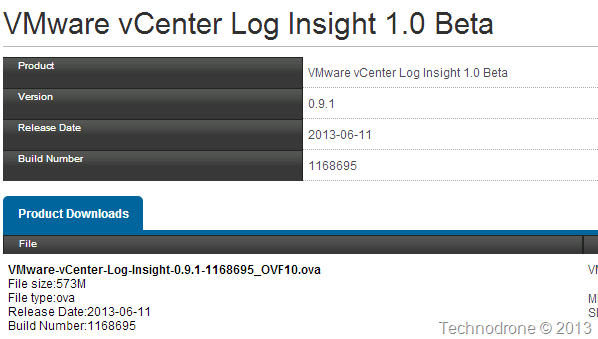
Just as a side note… Version 1.0 should not have a version number of 0.9.1 - that does not make sense…

1.0 or 0.9.1
1.0 or 0.9.1

Give it a spin - and le me know what you think about it?