Showing posts with label Announcement. Show all posts

2019-06-12

Starting a new Journey #AWS

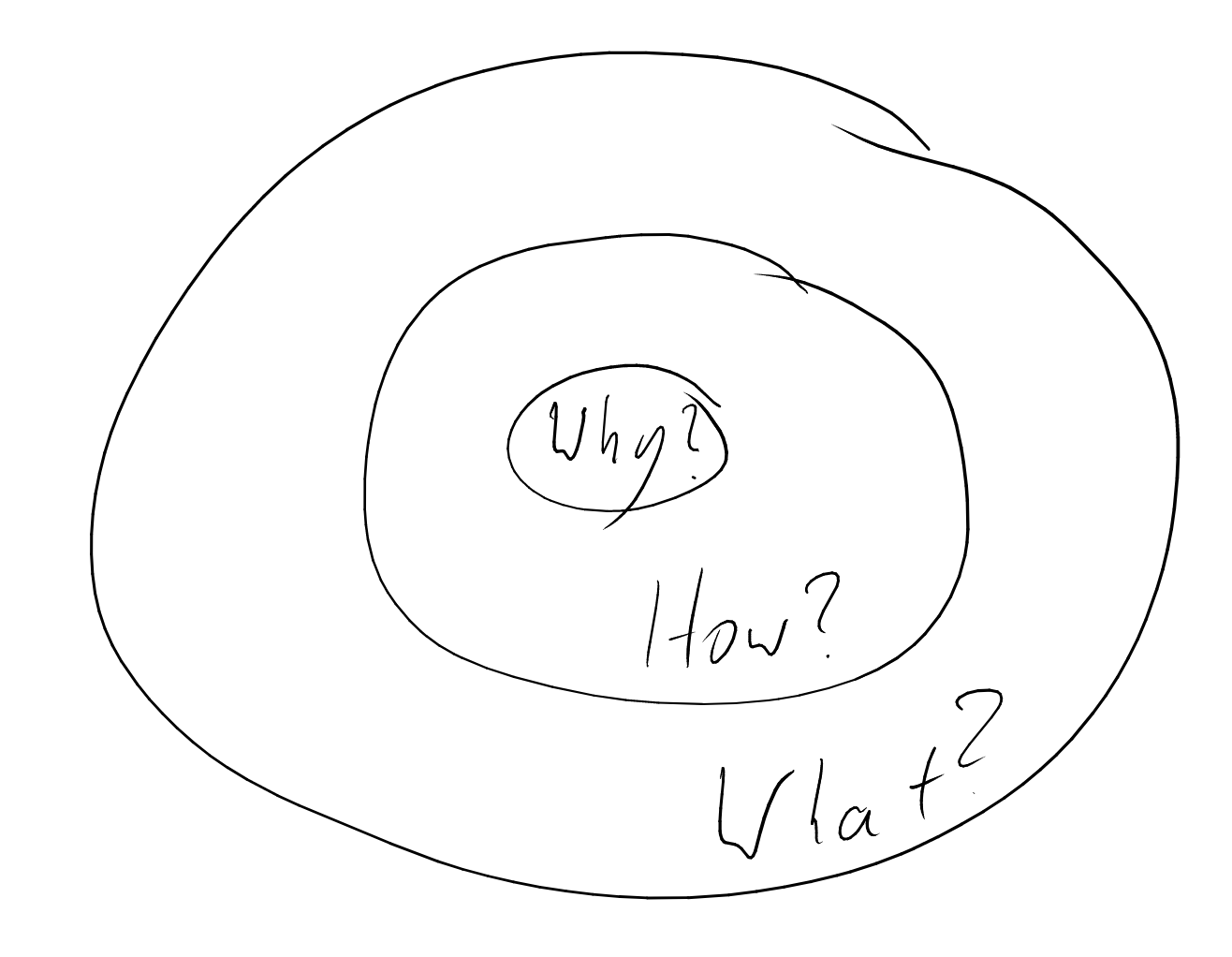
Simon Sinek has a great talk - about how great leaders inspire great action. I learned something really important from this talk even through it is almost 10 years old.


By explaining things in the wrong way - we miss the opportunity to make a great impact, to change the world.
  1. We usually start with the What.
  2. Then the How..
  3. And only at the end - we get into the Why...

It should be the other be the reverse.

Following Simon's advice I will start with the why..

How?  Why?  What?

Why?

I firmly believe that the future is the public cloud. I believe that we can accomplish so much more, so much faster, when we leave heavy lifting for others. This allows all of us to focus on providing the actual value to our customers without having to worry about the underlying infrastructure.

I know that I have a huge amount still to learn, but I also have a huge amount of knowledge, experience and insight that I can share with others. I have been doing this for many years, and see this not only as a way to put bread on the table, but also a way to make a real change in the world.

I want other people to benefit from what I have to give.


How?

I work with teams on how to start their journey to the cloud, how to make use of the technologies available to them. This includes, writing code, continuously learning (myself included), gaining more knowledge, and ultimately sharing that knowledge with others. I have built pipelines, migrated workloads into the cloud, failed miserably in some cases, continuously improved and iterated to get better the whole time.

Working on a regular basis with customers to help them on their journey, through their challenges along the way, celebrate their success stories with them, experience the pain and anguish with their failures / disasters - but above all - to be an advisor for my clients - with their best interests in mind.


What?

The change I have decided to embark on (and the challenge I have decided to accept) is moving my skills and energy in a direction where I feel I can make even more of an impact, help more people, help even more organizations, and not only focus on a single company, but make even a bigger impact.

Starting July 15th I will joining Amazon (Web Services) as a Senior Solutions Architect.

I will be working with an amazing team of solutions architects and talented people in a company that I really believe can change the way we use technology, make it better, more efficient, and do amazing things.

My last day at CyberArk will be June 30th, then I go on a long deserved and well earned vacation for two weeks.

I have learned a huge deal at my time here at CyberArk, worked with amazing people, learned a lot about the security space, their challenges, their fears, their constraints. None of it is easy. It is not a cloud native world and the problems this industry faces are not easy ones to solve, especially in what could be termed as "legacy" environments. For all this knowledge, the insight and experiences over the last year - I am extremely grateful.

I cannot wait for day 1 on July 15th!!!

2018-10-15

How Long Until you Get the New Shiny Toys from re:Invent?

re:Invent is coming - and the frenzy of releases that will build up to the event is just around the corner.

I have always had in the back of my mind that all the products announced at re:Invent are great for the press releases and the small digs at other vendors, but sometimes it takes a while until we actually get what was announced on stage in front of ~20,000 people and the rest of the world.

And I went out to look for some data. It is obvious that not everything that we heard about on stage was baked and ready for production use.

Andy Jassy - re:invent 2017 keynote

Here are some examples from last years re:Invent


re:Invent 2017

EKS (188 days)

https://aws.amazon.com/blogs/aws/amazon-elastic-container-service-for-kubernetes/
https://aws.amazon.com/blogs/aws/amazon-eks-now-generally-available/ (June 5, 2018)

 
Bare Metal (170 days)

https://aws.amazon.com/blogs/aws/new-amazon-ec2-bare-metal-instances-with-direct-access-to-hardware/
https://aws.amazon.com/about-aws/whats-new/2018/05/announcing-general-availability-of-amazon-ec2-bare-metal-instances/ (May 17, 2018)

 
Serverless App repo (83 days)

https://aws.amazon.com/blogs/aws/aws-serverless-app-repo/
https://aws.amazon.com/blogs/aws/now-available-aws-serverless-application-repository/ (Feb 21, 2018)

 
Neptune (183 days)

https://aws.amazon.com/about-aws/whats-new/2017/11/amazon-neptune-fast-reliable-graph-database-built-for-the-cloud/
https://aws.amazon.com/blogs/aws/amazon-neptune-generally-available/ (May 30, 2018)

 
Aurora Multi-master (Still not released)

https://aws.amazon.com/about-aws/whats-new/2017/11/sign-up-for-the-preview-of-amazon-aurora-multi-master/
Yet to be released (Oct 14, 2018)

 
Aurora Serverless (254 days)

https://aws.amazon.com/blogs/aws/in-the-works-amazon-aurora-serverless/
https://aws.amazon.com/blogs/aws/aurora-serverless-ga/ (Aug 9, 2018)

 
IOT 1-click (169 days)

https://aws.amazon.com/about-aws/whats-new/2017/11/aws-iot-one-click-now-in-preview/
https://aws.amazon.com/about-aws/whats-new/2018/05/aws-iot-1-click-generally-available/ (May 16, 2018)

 
Translate (127 days)

https://aws.amazon.com/blogs/aws/introducing-amazon-translate-real-time-text-language-translation/
https://aws.amazon.com/blogs/aws/amazon-translate-now-generally-available/ (Apr 4, 2018)

 
Transcribe (127 days)

https://aws.amazon.com/blogs/aws/amazon-transcribe-scalable-and-accurate-automatic-speech-recognition/
https://aws.amazon.com/blogs/aws/amazon-transcribe-now-generally-available/ (Apr 4, 2018)

 
Appsync (137 days)

https://aws.amazon.com/blogs/aws/introducing-amazon-appsync/
https://aws.amazon.com/about-aws/whats-new/2018/04/aws-appsync-now-ga/ (Apr 13, 2018)

 
S3 Select (126 days)

https://aws.amazon.com/blogs/aws/s3-glacier-select/
https://aws.amazon.com/about-aws/whats-new/2018/04/amazon-s3-select-is-now-generally-available/ (Apr 3, 2018)


re:Invent 2016

Lex (141 days)

https://aws.amazon.com/blogs/aws/amazon-lex-build-conversational-voice-text-interfaces/ https://aws.amazon.com/blogs/aws/amazon-lex-now-generally-available/ (Apr 19, 2017)

 
PostgreSQL for Aurora (329 days)

https://aws.amazon.com/blogs/aws/amazon-aurora-update-postgresql-compatibility/ 
https://aws.amazon.com/blogs/aws/now-available-amazon-aurora-with-postgresql-compatibility/ (Oct 24, 2017)

 
GreenGrass (190 days)

https://aws.amazon.com/blogs/aws/aws-greengrass-ubiquitous-real-world-computing/
https://aws.amazon.com/blogs/aws/aws-greengrass-run-aws-lambda-functions-on-connected-devices/ (Jun 07, 2017)

 
X-Ray (140 days)

https://aws.amazon.com/blogs/aws/aws-x-ray-see-inside-of-your-distributed-application/
https://aws.amazon.com/blogs/aws/aws-x-ray-update-general-availability-including-lambda-integration/ (Apr 19, 2017)

 
Batch (36 days)

https://aws.amazon.com/blogs/aws/aws-batch-run-batch-computing-jobs-on-aws/
https://aws.amazon.com/about-aws/whats-new/2017/01/aws-batch-now-generally-available/ (Jan 5, 2017)

 
Lambda Edge (229 days)

https://aws.amazon.com/blogs/aws/coming-soon-lambda-at-the-edge/
https://aws.amazon.com/about-aws/whats-new/2017/07/lambda-at-edge-now-generally-available/ (Jul 17, 2017)

 
At a glance it looks like the average amount of time from the list above was about 5 months.

Now don’t get me wrong. For all of the above items that were not actually available at re:Invent - I would estimate that there were the same number of products (if not more) that were available (at least in a limited number of regions) the same day they were announced. Above and beyond - the problems that AWS is trying solve and really complex - and a almost all of them have never been done before - so please AWS take your time in developing the game changing technology that you have been giving to the world.

So when Andy Jassy and Werner Vogels get up on stage at the end of November, and announce whatever wonderful stuff they are going to announce - we should all take into account that it could take anything from 1 day to almost a year until we can actually use it in all the AWS regions that we are consuming today.


Werner Vogels - re:invent 2017 keynote

How can this / does this affect you? I can give an example from the EKS announcement. We were actively looking at a kubernetes deployment on AWS and were contemplating whether we should deploy our own or wait for the managed solution that was announced at re:Invent.

Since we did not have an official release date - we decided to roll our own - and not wait for some some unknown time in the future.

It is nice to know what is coming. You will need to evaluate how long you can wait - are you ready to go with a version one product (that could / will probably have a good number of limitations) or come up with a contingency plan to solve your issues.

2018-07-19

The #AWS World Shook and Nobody Noticed

A few days ago at the AWS Summit in New York there was an announcement which in my honest opinion went very noticeably under the radar and i don't think many people understand exactly what it means.
The announcement i'm talking about is this one EC2 Compute Instances for Snowball Edge
Let's dig into the announcement. There are new instance types released the sbe1 family which can been on AWS Snowball Edge device which essentially a computer with a lot of disks inside.

The Snowball is a service that AWS provides to enable you to upload large amounts of data from your datacenter up to S3. Since its inception it is actually a very interesting concept and to me it has always been as a one off way enticing you to bring more of your workloads and your data in a much easier way to AWS.

I also posted this on Twitter

Since its inception AWS has always beaten the drum and pushed the message that everything will run in the cloud - and only there. That was the premise they build a large part of their business model upon. You don't need to run anything on-premises because everything that you would ever want or ever need is available on the cloud, consume as a service, through an API.

During the course of my career a number a number of times the question came up asking, "Does AWS deploy on-prem?" Of course the answer was always "No, never gonna happen."

Most environments out there are datacenter snowflakes, built differently, none of them look the same, have the same capabilities, features or functionality. They are unique and integrating a system into different datacenters is not easy. Adapting to so many different snoflakes is really hard job, and something we have been trying to solve for many years - trying to build layers of abstraction, automation and standards across the industry. In some way we as an idustry have suceeded, and in others we have failed dismally.

In June 2017 AWS announced general availability of GreenGrass. A service that allows you to run Lambda functions on Connected devices wherever they are in the world (and more importantly - they are not part of the AWS cloud).

This is the first leg in the door - to allow AWS into your datacenter. The first step of the transformation.

Back to the announcement.

It seems that each Snowball is a server with approximately 16 CPUS's and 32GB of RAM (I assume a bit more to manage the overhead for the background processes). So essentially a small hypervisor - most of us have servers which are much beefeir than this little box - as our home labs or our laptops even. It is not a strong machine - not by any means.

But now you have a the option to run Pre-provisioned EC2 instances on this box. Of course it is locked down and you have a limited set of functionality availble to you (the same way that you have a set of pre-defined option availble in AWS itself. Yes there are literraly tens of thousands of operations you can perform - but it is not a free for all).

Here is what stopped me in my tracks

EC2_endpoint
Connecting and Configuring the Device
After I create the job, I wait until my Snowball Edge device arrives. I connect it to my network, power it on, and then unlock it using my manifest and device code, as detailed in Unlock the Snowball Edge. Then I configure my EC2 CLI to use the EC2 endpoint on the device and launch an instance. Since I configured my AMI for SSH access, I can connect to it as if it were an EC2 instance in the cloud.

Did you notice what Jeff wrote ?
"Then I configure my EC2 CLI to use the EC2 endpoint on the device and launch an instance"

Also this little tidbit..

S3_Endpoint
"S3 Access – Each Snowball Edge device includes an S3-compatible endpoint that you can access from your on-device code. You can also make use of existing S3 tools and applications"
That means AWS just brought the functionality of the public cloud - right into your datacenter.

Is it all the bells and whistles? Infinitely scalable, can run complex map reduce jobs? Hell no - this is not what this is for.  (Honestly - I cannot actually think of any use case that I personally would want to run a EC2 instance on a Snowball - at least not yet).

Now if you ask me - this is a trial balloon that they are putting out there to see if the solution is viable - and something that their customers are interested in using.

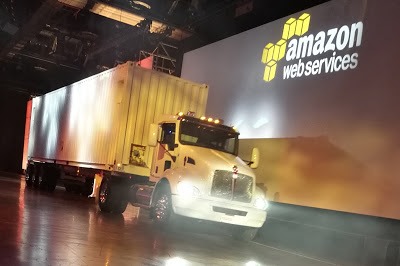
If this works - for me it is obvious what the next step is. Snowmobile 

SnowMobile

Imagine being able to run significantly more workloads on prem - same AWS experience, same API - and seamlessly connected to the public cloud.

Ladies and gentlemen. AWS has just brought the public cloud smack bang right into your datacenter.

They are no longer only a public cloud only company - they provide hybrid cloud solutions as well.


If you have any ideas for a use case to run workloads on Snowball - or if you have any thoughts or comments - please feel free to leave below.

2018-04-09

Time for a New Chapter - Hello CyberArk!


A bit of history

After 13 years at Cisco - I have decided to challenge myself and embark on a new adventure.

I first would like to express my gratitude to those who have helped me grow over the years.

Starting out 13 years I was part of the helpdesk at a company called NDS (who was acquired by Cisco about 5 years ago), Supporting users over the phone, servicing desktops and laptops.

From there I moved to the systems group and managing Active Directory and assumed additional responsibilities.  Over the years I architected and deployed one of the largest VMware deployments in Israel, and continued to grow with the technologies within the company, grow professionally to where I am today.

The people I have had the honor to work with over the years, are the greatest resource I will take with me for the future and the one I will miss the most. The crazy projects we pulled off, the outrageous ones that sometimes did not - these are things that I will always cherish.

From every experience over the years, I have learned something new, and it has allowed me to grow. For that I am eternally thankful.

Why am I leaving Cisco?

13 years is a long time to stay at one company and it is time for a change, time for bigger challenge. Cisco has allowed me to grow immensely, pivot to new technologies over the years and play with stuff day in and day out. Leaving was a hard decision, because change is a scary thing, scary for me, scary for anyone. I know the people, I know the company, I know the ropes.

In spite of all this - I needed a change, an opportunity to explore new technologies, new areas of interest


change-948016_1280

Hello CyberArk!

Starting from Monday, April 16th, I will be assume the position of DevOps & Cloud Architect at CyberArk.    I am really excited to start this new journey.

CyberArk is the only security company laser-focused on striking down targeted cyber threats, those that make their way inside to attack the heart of the enterprise. Dedicated to stopping attacks before they stop business, CyberArk is trusted by the world’s leading companies — including more than 50% of the Fortune 100 — to protect their highest-value information assets, infrastructure and applications.

I will continue to be involved in AWS, branching out in to additional cloud providers as well, and focused on allowing CyberArk to expand their offerings to allow their customers the choice of running a best of breed solution in the location of their choice, and some new and innovative ways of securing their organization and resources in the cloud as well.

(I know that I have neglected this blog for a good part of a year (for a number of reasons) - something that I am going to rectify starting next week)

I am so excited, and hyped to start this new chapter !!!

2017-11-23

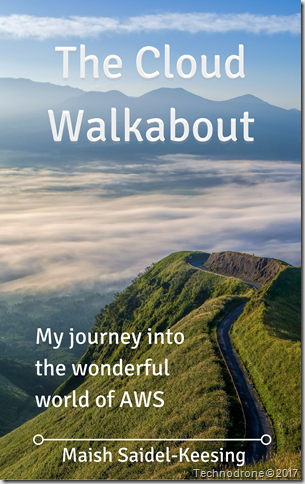
The Cloud Walkabout #AWS

Some people say that once you write a book - you never stop at only one. I think I tend to agree. There is something about creating something from nothing, and even more so for me - I enjoy sharing the knowledge I have accumulated with the rest of the world. I think I have always been this way. This blog would not exist if that was not the case.

I would like to introduce you all to my latest project.

The Cloud Walkabout

My focus has changed - a number of times over the years, first from Microsoft, then to VMware, on to OpenStack and now my day to day job has me focused exclusively on AWS.

The book is currently in production - and I expect to have a new chapter available on a monthly schedule.

Please take a few minutes to read my previous post - Self Publishing my New Book #AWS and understand how Leanpub works.

Even more so - I am asking you to choose how much you pay for it. There is a minimum price - but you can choose how much you think this book is worth to you. Yes - It might sound a bit crazy - but I have faith in you my readers, that this book will be of a huge benefit to all that read it and you should decide how much would like to pay.

Currently I am only publishing a digital version - when the book is complete - there will probably be a print version as well - we will see what the future holds..

The book is available for pre-purchase today - and this includes the first 3 chapters that are available today (if you would like a sample for free - it is available as well).

Please visit http://cloudwalkabout.com today for your copy.

The most important thing for me is feedback. I would like to hear from you what think about the book, are there parts that you think need improvement, are there things that are missing, or whatever you feel like sharing.

Feel free to reach out me either on Twitter, through this blog or on the book page.

2016-10-16

VMware on AWS - My Thoughts

The world shook a few days ago, with the announcement of a partnership between VMware and AWS.

Screenshot at Oct 15 21-46-03

There are a number of posts that have been released, by a number of bloggers and analysts,  about what this actually means but I would like to highlight 3 of them, and also insights from the Joint announcement and my thoughts on the matter as whole.

So first some history, VMware has always perceived AWS as a competitor. It is no secret that VMware over the years (https://gigaom.com/2013/03/01/vmware-stick-with-us-because-amazon-will-kill-us-all/) have warned their customers about going to AWS. Some of the claims included (but not only):

  • Why this is bad thing.
  • One way ticket – vendor lock-in
  • Enterprise workloads are not suitable
  • The list goes on.

VMware even has (or had) specific playbooks and marketing decks that were used to explain to their customers why vCloud (or vCloud Air) was a much better choice that AWS.

So first facts.

The Announcement

This was the slide that was presented on the live broadcast.

Screenshot at Oct 15 21-48-35

  1. An integrated hybrid cloud service.

    To me that means that I can move my workloads from my on-premises Private Cloud to a Public Cloud Provider – and in this case it would be AWS.

    One thing that should be made clear off the bat.

    The offering that was announced – is not a hybrid solution. What VMware is offering is the option to place your workloads either in your on-premises Private Cloud or in another Private Cloud which is located in a 3rd party Datacenter – in this case – AWS. VMware are trying to position and sell as something that it is not.

    You are not making use AWS as a cloud provider – all you are doing is using them as a 3rd party bare metal provider.
  2. Jointly Architected Solution

    Yes there was some work needed on both sides. But honestly – I think the work was almost completely on the part of VMWare, and hardly any investment on the part of AWS. Let me explain why.

    If you look at what AWS offers today, they are not adding, removing, or changing anything at all in their infrastructure to accommodate this offer. Perhaps they are ensuring that there will be enough capacity to run the solution – but nothing besides that has to change.

    It could be I am wrong – but this is how I would envision how the product would work.

    Once a new Cloud is ordered (see screenshot from Demo below) VMware will go and request the appropriate bare metal hosts from AWS – by invoking an API, install ESXi on the hosts and then provision all the additional building blocks on top of it. I assume that a lot of the work that will bring up this infrastructure will be using the work and the expertise of the people in Project Zombie which already is being used (I hope) for building up vCloud Air.

    Screenshot at Oct 15 21-18-38

    What does AWS have to do allow this solution to work? Nadda, it already exists – anyone can request a bare metal server.

    On second thought, I may be exaggerating – they probably did and will provide an AMI (Amazon Machine Image) with ESXi readily installed – to make things move a bit faster.

    (An interesting tidbit of info that comes out this relationship, that the AWS proprietary hardware – will now be certified to run ESXi)

    So if we look again. What effort was needed on AWS’s part – I assume the AMI image (perhaps some other background stuff – which we do not know about). From the VMware perspective – writing the code to call the correct AWS API’s for the bare metal nodes, the code to provision all the nuts and bolts on the servers and of course let us not forget the required work that went into certifying the proprietary AWS hardware that they use. If you are aware of it – or not, AWS builds their own hardware in direct partnership with hardware manufacturers, they don’t run brand names. At the scale they are functioning – it does not make sense.

    (So just as side bit of information – unless this is a specialized version of ESXi –  it might be – but I assume that the changes will make it into the default code base at some point because maintaining a specific branch, just for AWS does not make sense. In the future you probably will be able to deploy your own bare metal node from AWS and install ESXi on it – all on your own – without the service from VMware. It will not be as polished as the service provided by VMware – but it should be possible. Once they have opened this Pandora’s box – it will be hard to close it)
  3. Primary Public Cloud Solution – delivered, sold and supported by VMware

    So as I said above – this is not really a public cloud solution solution – this is a Private cloud running on a Public Cloud on AWS – who are the suppliers are the bare metal servers. Is this way AWS are no different than any other vendor who provides the same service.

    They are not offering a public cloud solution running on top of AWS. They are not offering the option for you to deploy a Cloud solution that you will be able to sell to your customers. It is a vSphere ,VSAN and NSX environment that you use to your hearts desire. Your applications can use all of AWS’s other services – you cam already do that today – without running VMware on AWS.

    But it is not a Public Cloud.
  4. Run any application across vSphere based Private, Public and Hybrid Clouds 

    Finally something I can agree with!!
  5. AWS will be VMware’s primary Public cloud infrastructure partner, and VMware will be AWS’s primary private cloud partner

    So this one is interesting.

    Firstly, if I was a VMware vCloud partner – I would be very, very worried because there is no-one that can compete with the scale of AWS, and a statement like this one – saying that we have one main partner would put dampers on other partners. For example the partnership announced just over two months ago with IBM (https://www-03.ibm.com/press/us/en/pressrelease/50420.wss).

    The other side of the equation of AWS using VMware as a private cloud partner – is not something that I would take too seriously. AWS has always and still believes that everything should run in the Public cloud.

    What does AWS have to gain from this? Absolutely everything!!!

    VMware are trying to position this offer as a way to start using AWS resources – not with any kind of integration mind you – because from the information currently made available – there is no special integration done with VMware to make use of the AWS resources. Yes the announcement said they will be able to use AWS services – but it also was stated that the benefit here will be the proximity to AWS resources in each location – nothing more. That is a huge plus but then again, this is something that anyone can do today, running from within AWS or running from with their own datacenter. It is just a matter of proximity, not any technological advantage.

    In addition – when VMware users start learning about the plethora of available services that they can use while in AWS  they will see that it might start to make sense to use them natively – without running first on VMware.

    Screenshot at Oct 15 22-13-10

    The above screenshot was from Jeff Barr’s blog post, which I think points towards the future direction and why AWS were ready to accept this with open arms.

    They view the workloads that will run in VMware on AWS as old fashioned, historical applications (and there will always be a need for such applications). And when you the User are ready to grow up and move forward to the future – we are ready to help and will accept you with open arms, you are already half the way there.

    The same as well when you are interested to scale your application – then we have the capacity and the geographical spread to help you out. Just know that running it on VMware might not be your best bet.

    I am sure they are betting on the fact that once they have the workload in an AWS datacenter – the path for migrating off of VMware into AWS native will not be so scary.

Elastic DRS

Screenshot at Oct 15 21-37-23

Technologically speaking this is being made out be a much bigger feature than it really is. For a shop that is heavily into automation – how hard is it to actually scale up your cluster? Honestly – I think the biggest thing would be to order the actual hardware, rack it and stack it. The rest of it really trivial, installing ESXi, Host profiles and adding it to a cluster – is all something that we know how to do, and if we really did some work, automate it up the wazoo.

This is a very simple thing to now to do for VMware in this solution – all they need to do is make an API call to provision a new bare metal server and do all the magic behind. No more rack and stack, no more waiting for hardware to arrive – no more doing things the old way. They have a theoretically infinite supply of hardware to run VMware workloads – so this makes perfect sense. 

The Demo – was just that – a Demo

The demo showed the provisioning of an environment in AWS.

Screenshot at Oct 15 21-28-32

There is no way in hell, ever, that a 4 host cluster with VSAN and NSX, could be provisioned in less than 3 minutes. The installation of all that software – including vCenter  (especially vCenter) is not that fast.

I would suppose that it would take an hour or two to actually provision all the pieces to get it up and running.

Screenshot at Oct 15 21-30-46

(So just for purposes of bike shedding, do you start paying per hour – from the time that you click go – or from the time that the resources are fully available)

Cost

Last but not least – the matter of how much this is going to cost.

There is no denying that this is going to open up a huge amount of options to people who previously were limited in scale because of power, space, hardware limitations, etc.

But this is not going to be cheap. And let us all be honest – the amount of people that are going to use this as on per-hour basis – is going minimal. The majority of customers will use this on a regular basis – trying to maximize the resources they can use for the lowest cost possible.

Doing the math on the amount of CPU and RAM available in the cluster size offered in the demo – it seems that the Dedicated Host type will probably be a an M4.

The monthly cost of an M4 (without even putting any VMware software on it is $1451.90 x 4 servers – means we are looking at ~$6,000 for hardware alone per month.

I assume that VMware are going to want to factor into this the costs of licensing and operations – remember – this is a fully managed service that you are getting (which also brings up a question – how much control do you have over the underlying infrastructure, I assume none).

The current cost for a vCloud host (Dedicated Cloud) is just short of $6,000 per month – without support. I can envision that VMware manage to keep the costs more or less the same as they have up until now – but it will definitely be a good idea to run a proper cost-analysis to see if this is something that will be good for and your organization.

Summary

AWS will be the ones to benefit the most from this in the long run.

VMware are making this out to be a much bigger deal than it actually really is.

As always – please feel free to leave your thoughts and comments below.

2014-07-28

VMCI – revisited (a.k.a. Project Marvin)

You all know what VMCI stands for – don’t you? Well if you ever looked at VMware solutions – then you would recognize it - VMCI Overview.

The Virtual Machine Communication Interface (VMCI) is an infrastructure that provides fast and efficient communication between a virtual machine and the host operating system and between two or more virtual machines on the same host. The VMCI SDK facilitates development of applications that use the VMCI infrastructure. Without VMCI, virtual machines communicate with the host using the network layer. Using the network layer adds overhead to the communication. With VMCI communication overhead is minimal and different tasks that require that communication can be optimized. An internal network can transmit an average of slightly over 2Gbit/s using vmxnet3, VMCI can go up to nearly 10Gbit/s with 128k sized Queue pairs.

In my 10 years (I think it has been 10) of using VMware products – I personally have never seen any public implementation of VMCI, even though it is in theory an interesting concept.

It seems though that VMware are looking to re-brand the acronym into something else, which is connected with something that a number of rumors have been flying around about a converged infrastructure offering to be announced by VMware.

The rumors started a while back and the whole story became apparent in these articles.

Project Mystic's Potential Competitors To VMware: Bring It On

So, Mystic Joe Tucci: Is a hyper-converged tool in EMC's future?

VMware Teaser Gets Tweeted: 'Marvin' Hyper-Converged Infrastructure Appliance

VMware to offer converged compute and storage hardware

What is VMware’s Mystic Marvin Project?

Pure Speculation Post: Some more Marvin Speculation

I was going over the Content catalog for VMworld and noticed something.
*(by the way if you ever want to find out what is going to happen at VMworld – then I can assure you that you will find it in the content catalog)

I am talking about the following VMworld session.

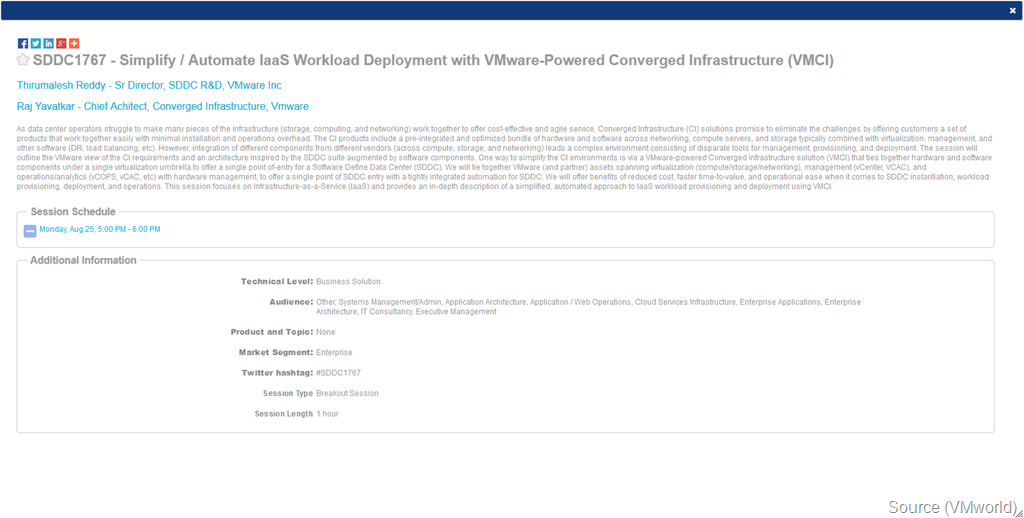
SDDC1767 - Simplify / Automate IaaS Workload Deployment with VMware-Powered Converged Infrastructure (VMCI)

  • Thirumalesh Reddy - Sr Director, SDDC R&D, VMware Inc
  • Raj Yavatkar - Chief Achitect, Converged Infrastructure, Vmware

    As data center operators struggle to make many pieces of the infrastructure (storage, computing, and networking) work together to offer cost-effective and agile service, Converged Infrastructure (CI) solutions promise to eliminate the challenges by offering customers a set of products that work together easily with minimal installation and operations overhead.
    The CI products include a pre-integrated and optimized bundle of hardware and software across networking, compute servers, and storage typically combined with virtualization, management, and other software (DR, load balancing, etc). However, integration of different components from different vendors (across compute, storage, and networking) leads a complex environment consisting of disparate tools for management, provisioning, and deployment.
    The session will outline the VMware view of the CI requirements and an architecture inspired by the SDDC suite augmented by software components.

    One way to simplify the CI environments is via a VMware-powered Converged Infrastructure solution (VMCI) that ties together hardware and software components under a single virtualization umbrella to offer a single point of-entry for a Software Define Data Center (SDDC). We will tie together VMware (and partner) assets spanning virtualization (compute/storage/networking), management (vCenter, VCAC), and operations/analytics (vCOPS, vCAC, etc) with hardware management, to offer a single point of SDDC entry with a tightly integrated automation for SDDC.
    (The highlighting was added by me)

    We will offer benefits of reduced cost, faster time-to-value, and operational ease when it comes to SDDC instantiation, workload provisioning, deployment, and operations. This session focuses on Infrastructure-as-a-Service (IaaS) and provides an in-depth description of a simplified, automated approach to IaaS workload provisioning and deployment using VMCI.

    Attached below id the screenshot of the session.

    VMCI

    So ladies and gents – there you have it - VMCI – VMware-Powered Converged Infrastructure. This will open up a whole new market for VMware – and of course a number of new co-opetition relationships with VMware’s current partners as well.

    I expect that this will be one of the major announcements at VMworld.

    Stay tuned.

    Disclaimer:

    This is based on public information that is currently available on the links above – and has not yet been confirmed by VMware (I doubt it ever will be).

  • 2013-06-26

    vSphere Big Data Extensions v1.0 Beta

    VMware vSphere Big Data Extensions 1.0 Beta - Release Notes

    VMware is proud to announce the VMware vSphere Big Data Extensions v1.0 beta. This product is designed to work with vSphere and leverages the VMware contributions to the Serengeti Project.

    Big Data Extensions gives customers an easy to use management tool to provision, manage, and monitor enterprise Hadoop clusters on vSphere through the vCenter user interface.

    What's New in vSphere Big Data Extensions

    vSphere Big Data Extensions is a virtualization platform that enables provisioning and lifecycle management of Hadoop on VMware vSphere. This release provides the following features andProject Serengeti enhancements.

    • Big Data Extensions Graphical User Interface.

      You can perform the following tasks with the Big Data Extensions graphical user interface.

      • Create, scale-out, and delete clusters.
      • Manage vSphere resources for use by Hadoop clusters.
      • Manage and monitor Hadoop clusters.
      • Control Hadoop resource usage.
    • Support for all Major Hadoop Distributions.
    • Automatic Elasticity.
    • Adjust the Compute and Memory Resources of Running Hadoop Clusters.
    • Disk Failure Recovery.
    • Create a Hadoop Virtual Machine with a Custom Linux CentOS Operating System Configuration.
    • Support for vSphere Standard Edition When Using the Technology Preview.

    vSphere Big Data Extensions Administrator's and User's Guide
    vSphere Big Data Extensions Command-line Interface Guide

    I am sure this will be of use to those who are already using Project Serengeti