Showing posts with label Book. Show all posts

2019-06-10

Book Review: Mastering AWS Cost Optimization

I dabble in AWS every now and again :) and a new book just came out - so obviously I wanted to go through it and give it a read.

Mastering AWS Cost Optimization: Real-world technical and operational cost-saving best practices
(Eli Mansoor and Yair Green)


So first some disclosure - I have met with Eli a few times throughout my career - we had some business discussions during his Rackspace days. Eli Reached out to me and asked me to read the book and post a review. 

I received a free paperback copy. 

I finished the book in two days, (it was chag and I had a lot of time to read). It quite clear that a lot of knowledge and detail went into the writing of the book. 

Eli and Yair took a methodological approach throughout the book. They focused on three main aspects of your AWS cost (with a strong emphasis on Compute and Storage, but also Networking).

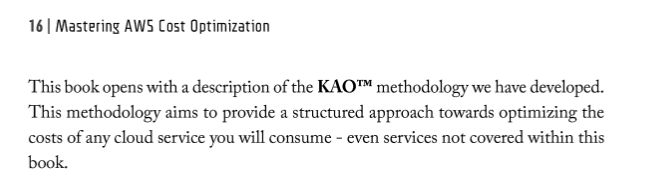
They used a methodology which they name KAO (Knowledge, Architecture, Operation) which in my honest opinion provided a logical and clear flow for the book and made it an easy read. 

KAO Methodology
They go into detail on how each of the services are used - sometimes in really great detail. There are a number of examples in the book used to explain how things exactly work. 

The last section of the book is focused on Operations with different suggestions and recommendations on how to adjust you current practices, to become more "cost aware/optimized". I for one would have preferred that this section would have been more of the focus of the entire book - but that could just be me. There are a great number of gems in this section - that has something new for everyone (me included!!)  

As I said, this was an easy read, well structured and very informative. Eli and Yair have done a great job, diving deep on a topic that is important to us all (but has no real good source of information - besides experience) - but have also left enough space to expand on this book and to provide a more detailed deep dive and focus on more specific subjects in the future.

I would definitely give it a read!

2017-11-23

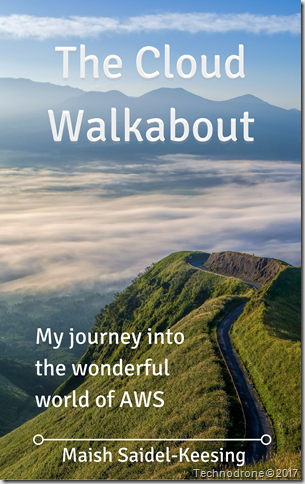
The Cloud Walkabout #AWS

Some people say that once you write a book - you never stop at only one. I think I tend to agree. There is something about creating something from nothing, and even more so for me - I enjoy sharing the knowledge I have accumulated with the rest of the world. I think I have always been this way. This blog would not exist if that was not the case.

I would like to introduce you all to my latest project.

The Cloud Walkabout

My focus has changed - a number of times over the years, first from Microsoft, then to VMware, on to OpenStack and now my day to day job has me focused exclusively on AWS.

The book is currently in production - and I expect to have a new chapter available on a monthly schedule.

Please take a few minutes to read my previous post - Self Publishing my New Book #AWS and understand how Leanpub works.

Even more so - I am asking you to choose how much you pay for it. There is a minimum price - but you can choose how much you think this book is worth to you. Yes - It might sound a bit crazy - but I have faith in you my readers, that this book will be of a huge benefit to all that read it and you should decide how much would like to pay.

Currently I am only publishing a digital version - when the book is complete - there will probably be a print version as well - we will see what the future holds..

The book is available for pre-purchase today - and this includes the first 3 chapters that are available today (if you would like a sample for free - it is available as well).

Please visit http://cloudwalkabout.com today for your copy.

The most important thing for me is feedback. I would like to hear from you what think about the book, are there parts that you think need improvement, are there things that are missing, or whatever you feel like sharing.

Feel free to reach out me either on Twitter, through this blog or on the book page.

2017-11-20

Self Publishing my New Book #AWS

If you have been following the hints that I have been dropping on Twitter - you may have noticed that I am about to go public with a new book.

Before I actually go live with the announcement - I would like to prepare you all for how this is going to work - because it could be slightly different from the conventional book launch you might be used to.
I have decided to use Leanpub.

Why did I choose to go with self publishing and not with a traditional publisher?

The main reason behind this is not money, of course royalties are a nice little surprise every now and again - but having co-authored more than one book - I can say with no doubt - we do not do it for the money - definitely not the money,
The main reason - is because of flexibility. I have the option to decide the content - and I am the sole owner of what I want to have in the book. I do not have an ‘overlord’ looking out over my shoulder saying that this is not good, not long enough - or the words are not clear. I decide what goes in, how it goes in and when.
This has it’s up-sides and of course its drawbacks - but that is a topic for a future post.

Why Leanpub?

After reading Jeff Geerlin’s book (Ansible for DevOps) and his posts on using Leanpub - I decided to try it out for myself, and I found…
  1. I love the workflow, git commits, working with Markdown - simple smooth and it just works.
  2. I did not want to wait for the whole book to be complete - because I think that what I have now will be highly useful - and there is no reason to wait until the end for the information to get out there.

So how does this work?

  • I am currently actively writing the book and if you so choose - you can purchase the book before it is finished.
  • You choose the price that you are willing to pay (there is a minimum charge).
  • All updates to the book are free.
  • Currently (until the book is complete) - there will only be a digital version (perhaps a paperback in the future).

What is the book about?

Quite obviously - AWS.

When already??

A few more days.. I promise I will let you all know when it ready for initial launch.

2014-08-08

The OpenStack Architecture Design Book Authors Speak

In the OpenStack Design Summit I asked the authors the same 5 questions in order to get their thoughts and feelings on OpenStack, the community and the future.
  1. How many years have you been working with OpenStack?
  2. What is your favorite thing about OpenStack?
  3. What is that you dislike about OpenStack?
  4. If there was only one thing you could change/improve in OpenStack - what would it be?
  5. Where do you think Openstack will be 3 years time?
Here are their responses.
Beth Cohen, Cloud Technology Strategist – Verizon
    1. 3 years.
    2. It is a strong community of companies and people who want to build the best cloud platform in the world.
    3. It is a bunch of petty developers snipping at each other from their little fiefdoms.
    4. Better integration of the parts.
    5. Everywhere!
Sean Winn, Cloud Services Network Engineer – CloudScaling
    1. 2 years.
    2. I love that OpenStack is an open-source, community-developed system which, when leveraged properly within an organization, can have tremendous impact on every aspect of how that company does business. The effects of OpenStack on business operational efficiency and agility are incredible to me.
    3. Lack of cohesiveness between projects is one of the biggest problems that I see facing OpenStack. Features are sometimes developed without consideration of other OpenStack projects implementations of same or similar features.
    4. More cooperative efforts between projects to develop features with parity.
    5. The most widely deployed data center and cloud solution.
Kenneth Hui, Business Development Manager, Cloud Solutions – EMC
    1. 2 years.
    2. The collaborative nature of the community.
    3. Lack of focus in terms of development. Too many people chasing the newest shiny thing.
    4. Better product management.
    5. Leading private cloud platform.
Nick Chase, Technical Marketing Manager - Mirantis
    1. 2 years.
    2. The "open" nature of OpenStack means that anybody can get involved, and anybody can make it do what they need it to, if they are willing to put in the work. The possibilities are endless, and I'm passionate about that.
    3. I'm sure there's much that I "dislike" exactly, though there are some things I wish worked better, or were easier to use. Deployment could be a little easier, of course.
    4. Public perception. :)
    5. Complete convergence so that hybrid and multi-cloud are not just normal but transparent.
Kevin Jackson, Principal Cloud Architect – Rackspace
    1. 3 years.
    2. The fact it's an open source, globally collaborated project that is the first choice when discussing cloud technologies that you can deploy yourself.
    3. Release cycle of 6 months with very little support at present to easily upgrade to match this cadence.
    4. Neutron/Networking - we need to quickly move on from the "Nova-network" vs "Networking" discussion ASAP.
    5. We'll see "OpenStack Compatible" stickers on hardware and software showing ease of integration with the standard privately deploy cloud software.
Anthony Veiga, Senior Network Engineer - Comcast
    1. 2 years.
    2. The flexibility to plug the parts I want and omit the parts I don't. Plus, it's open source so I can't parts I need (which my team has done a lot of).
    3. I dislike the primarily vendor-driven nature of its development. More users need to get involved, and the Foundation should recognize that coders aren't the only contributors.
    4. Add community processes for locking out intentional roadblocking.
    5. A multi-billion dollar per year industry.
Sean Collins, OpenStack Developer – Comcast
    1. 2 years.
    2. Being able to make design decisions that affect the entire company I work for.
    3. Gerrit, Nitpickers.
    4. Nitpickers.
    5. Probably where it is currently.
Vinny Valdez, Principal OpenStack Enterprise Architect - Red Hat
    1. 1 year.
    2. I particularly enjoy how expansive, dynamic and flexible all of the projects yet they all come together in unison.
    3. Many concepts sound great in theory but are not always proven or tested.
    4. Move everything to MongoDB.
    5. The de facto standard way to run applications.
Alexandra Settle, Technical Writer – Rackspace
    1. 1 year.
    2. The community involvement and dedication everyone has to the project.
    3. Unfortunately the documentation is not up to the greatest standard it could potentially be. This however is an ongoing project and I hope to see it through.
    4. Documentation.
    5. Hopefully still progressing. Lots of community based projects die once a 'bigger and better' project is introduced.
I would like to thank all the authors for an amazing week in San Jose – and amazing experience – and an amazing outcome.

2014-08-04

The OpenStack Architecture Design Guide Story

Over 6 weeks ago I posted that I was going to embark on a journey, another book journey, and this time it was an OpenStack one.

Go ahead and read the post OpenStack Design Guide Book Sprint.

I have been wanting to write this for a while – but so much has been happening – that I just have not yet got around it until now.

I first would like you all to visit these two posts:

As were the others, I was also skeptical about if such a process was even possible – but it was and I find it was actually a great success.

Everyone I have spoken to since the sprint was surprised that you actually can write a book in 5 days, it just shows that with a group of dedicated, task driven individuals – that have a deadline, and a common goal, it is possible.

So how did it actually work?

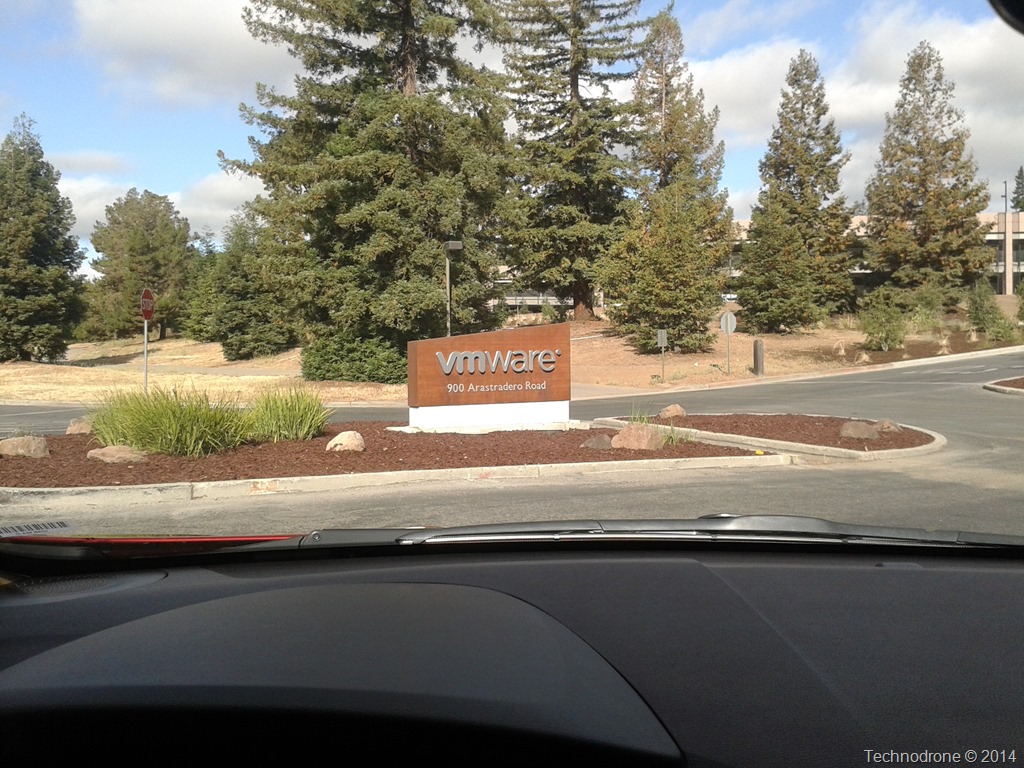
VMware (thanks to Scott Lowe) was kind enough to host us for these five days.

VMware Mothership

It was the first time I had actually been to the VMware campus – so this also was a first for me.

The diversity of the people involved was – I think – a good mix. There were Networking people, Openstack people, Architects, Storage Architects, Writers, Infrastructure Administrators, Project managers, a bit of everything. Each of us had input from a different aspect into the content that was going to go into the book and how it would be written.

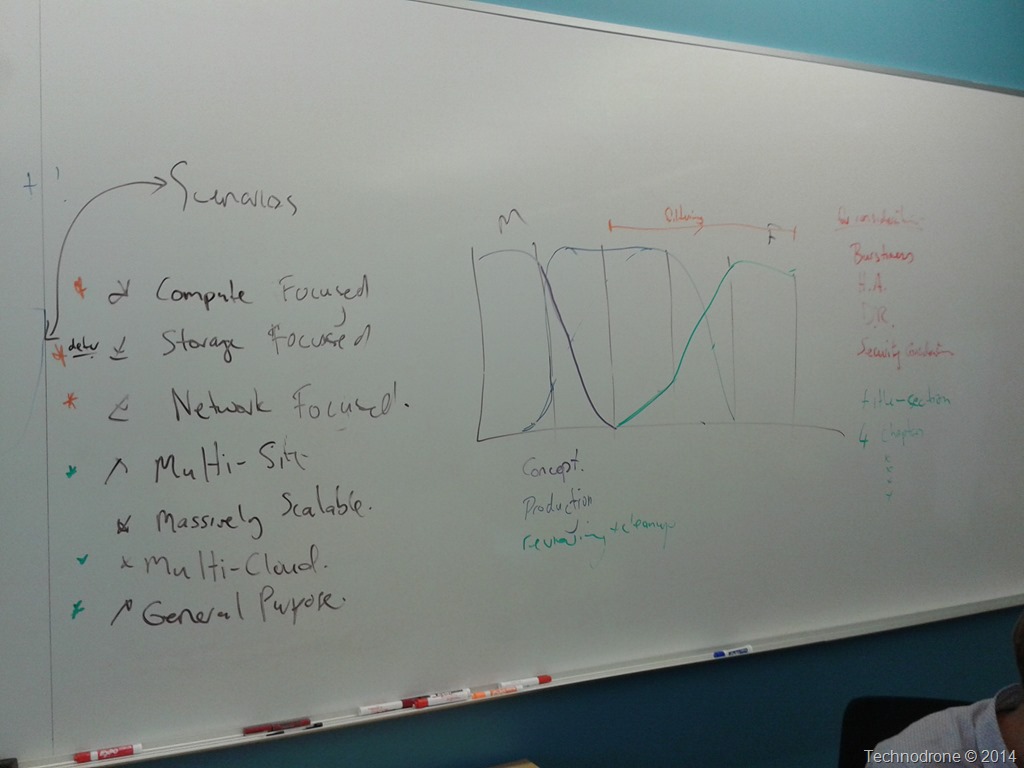
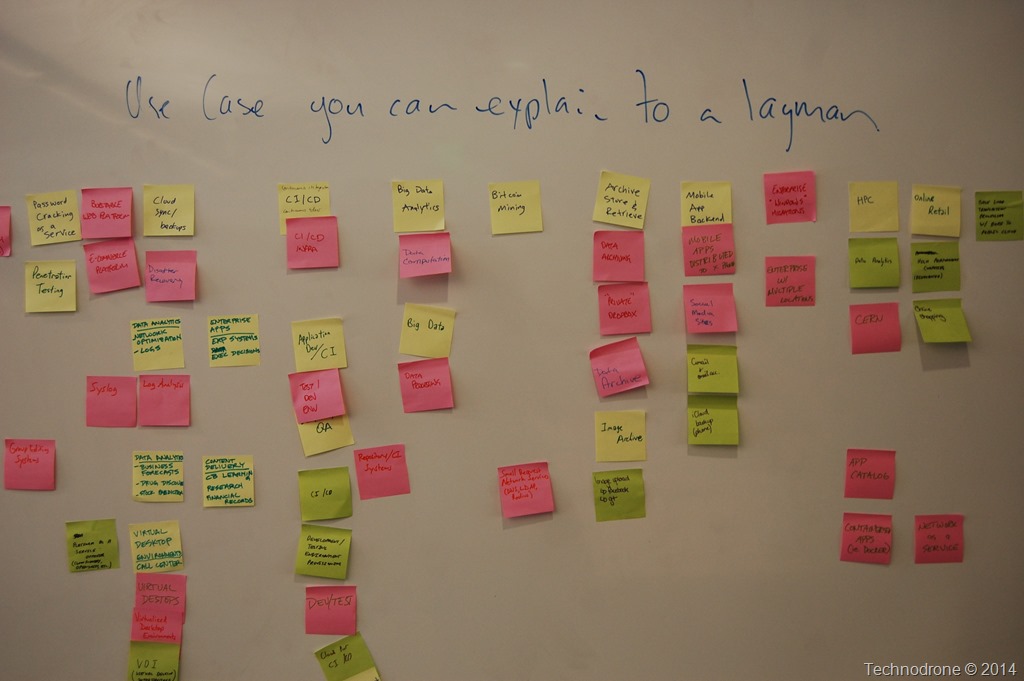
The first day was mostly dedicated to the book structure, what the content should be about – who the audience should be, layout and such.

Scenarios
Lots of Notes

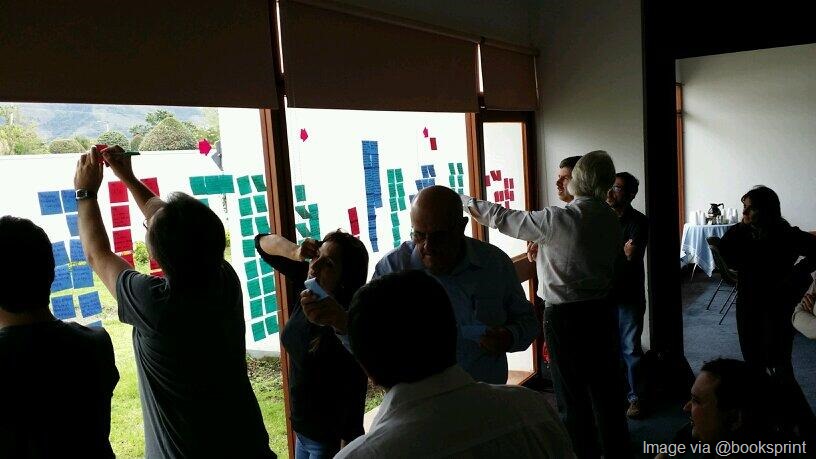
A good amount of brainstorming, discussions – getting to actually know each other – because not everyone was acquainted with everyone else.

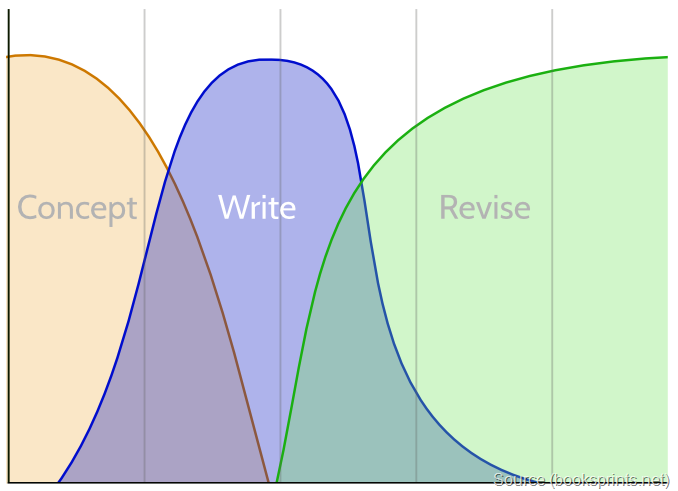
The graph on the picture above is actually better explained here

mapping

Each of the vertical lines is a day. As you can see the concept of what actually goes into the book is mainly done on Day 1 and a bit on Day 2. On Day 1 you also start creating the content where most of it is done on Day 2-4 – where at the end of Day 4 – almost all of the content is actually done. Revision starts on Day 3 and continues all the way till the end. And this exactly how it went.

We broke up into groups that would do the writing according to chapters. At first discussions in each group – what should go into the chapter, then high-level chapter points and then after that churning out content.

We had some problems with the software that we used, mainly because the majority of us are used to having tools where you can collaborate simultaneously on the same document (Google Docs or Etherpad) and here we were limited to one person on a section at a time. We found the middle ground of working with all of the above and synchronizing content – that allowed us all to work efficiently and keep the flow of the Sprint going.

I expected there to be some bottlenecks along the way – due to the fact that in order to have the book come out as though it was written in a “single voice” – it needed to go through what Adam (our moderator) called a “filtering process”. That mean it needs to go through one or two people that will organize the content with the same narrative, line of thought and style. And evidently that is what happened towards the end

Obviously we had different writing styles – so adaptations needed to be made along the way.

And so we trudged on – writing, editing, creating diagrams, and re-editing.

The combination of the constant supply of caffeinated soft drinks, M&M’s and other sugar saturated stuff, was about enough to get us through the sprint.

Getting to the end of Friday with checkmarks across the board was a very satisfying feeling.

All Done!

I had a great time, a wonderful experience. Out of all of the participants I had only ever met Scott Lowe, all the others were either through interaction over Twitter or other means, but not in person.

It was a enlightening experience, very satisfying and something I would definitely do again if I have the opportunity.

I hope my co-authors can forgive me for the Kosher food they had to eat during the Sprint – I must say home-made cooking (especially my wife’s) is a lot better than what we all got. So whenever you guys are are in Israel for a trip – I will be happy to invite you all for a home cooked meal.

And now for the finished product.

The online version…

Online version

Paperback – from Lulu.com

Paperback

You can browse through a full set of pictures taken at the event here.

All the authors have proposed a OpenStack Summit Session for the upcoming Paris Summit -
The OpenStack Design Guide Panel – please feel free to cast your vote!

2014-06-16

OpenStack Design Guide Book Sprint

It is said that once you get a bug in you – it is hard to get rid of it. I have been asked (and I have accepted) to participate in a book sprint commissioned by the OpenStack Foundation.

What is a book sprint you may ask? I am sure this will explain it better than I can – but in short…

A Book Sprint brings together a group to produce a book in 3-5 days. There is no pre-production and the group is guided by a facilitator from zero to published book. The books produced are high quality content and are made available immediately at the end of the sprint via print-on-demand services and e-book formats.

Book Sprint

A full book in 5 days? Is that even possible? Well, yes it is. There are a group of Subject Matter Experts coming together in the week of July 7th in Palo Alto (VMware are being so kind as to host us), where we sit and bash out a Design Guide/Book that will be used as the unofficial “bible” for OpenStack Architects wherever they may be.

Here is some more information about the two previous book sprints that were completed for the Openstack project.

OpenStack Security Guide: One Week, 38,000 Words, A Lot Of Security

OpenStack Operations Guide: One Week, One Book

The participants of this project will include:

And yours truly….

There is good participation from all parts of the globe and the OpenStack community – a diverse crowd – with different skills, experience and backgrounds.

I am really looking forward to this project – meeting such a group of interesting people, working on a new book project, but most of all – contributing back to the community – because that is what it is all about!

You can follow us all with the #openstackdesign hashtag for more information about this project.

2012-04-16

Automating vSphere With VMware vCenter Orchestrator

I had some time this past week to read Automating vSphere: With VMware vCenter Orchestrator by Cody Bunch.

I stand by my views that vCenter Orchestrator is one of those uncovered gems thatAutomating vSphere with VMware vCenter Orchestrator unfortunately not enough VMware professionals know how to use and do not make enough use of the product and the vast number of options and functionality available with the product (I must confess, I am just guilty as everyone else here).

Orchestrator has been a free product bundled with vCenter ever since the vCenter 4.0 (vCenter Orchestrator 4.0 | 15 April 2009 | Build 4240) and was installed by default with vCenter.

One of my biggest complaints about the product in its earlier version was that the documentation sucked! Really!! There was barely enough info about how to install Orchestrator correctly.

The documentation has improved immensely over the years and Orchestrator is finally being recognized for the useful tool it actually is. What I was still missing was a clear and concise how-to, down-to-earth explanation on Orchestrator and here is where I think Cody has done an extremely good job with this book.

I really liked the real-life scenarios and use-cases that Cody demonstrated. These scenarios are common to most environments and show how certain “annoying” tasks can be simplified in such a way that not only will your boss be amazed – but you will also have the time on your hands to do more important things (like creating even better workflows).

I would highly recommend this book to anyone who is interested in learning more about vCenter Orchestrator.

2011-05-09

VMworld Session Voting is now Open!!

Sorry for the shameless plug – but the amount of amazing sessions that are available are enormous –
1164 of them to be precise – and all of these are open for public voting.

Forbes Guthrie, Scott Lowe and yours truly have submitted a session as an opportunity to present your questions and voice your opinions on vSphere Design at VMworld. Tom Howarth has kindly agreed to moderate the session.

Session 1843
Your vSphere Design and a Session with the Experts

Abstract
Every infrastructure administrator would like to have the best of all worlds from their virtual infrastructure. You want a solid and sound foundation to build your datacenter and your cloud environment for the future. Join in this session with the 3 authors of VMware vSphere Design who have "written the book" on how to get the most out your environment. Come join us for a one hour panel session where you can quiz the Experts on your Virtual Infrastructure Design. Join the Virtualization Experts and Authors; Forbes Guthrie from vReference, Scott Lowe of EMC, and Maish Saidel-Keesing from Technodrone for chance to get the answers to your vSphere design problems.

I think that such a session will be beneficial to all that participate.

If you think so as well – then come on over and cast your vote on the Public Session Voting. You will need a VMworld account – which is easy to set up.

From the FAQ:

Q: Who can participate in Session Voting?
A: Anyone with a
vmworld.com account can vote.

Q: How long is Session Voting open?
A: Session Voting is open May 9 – May 18.

Q: Am I voting on sessions for both events – US and EMEA?
A: Yes, this is global and 80% of sessions selected will occur at both events.

Q: I’d like to vote on a specific track and/or session. How can I do this?
A: Once you login to the voting site, select a Track and a dropdown menu will appear with the relevant topics. You can also search by Area of Interest (Healthcare, SMB, etc.) or Keywords (Session ID, title, speaker, etc.).

Q: How many sessions can I vote on?
A: You can vote on as many sessions as you’d like. You can only cast one vote per session.

Q: How do I cast my vote?
A: Click on the “Thumbs Up” symbol next to the Session ID. You will receive confirmation that your vote has been counted. To remove a vote, you will need to click on the on the “Thumbs Up” symbol again and this will remove the vote.

Q: Will my votes be saved?
A: Yes, your votes will be saved and you will be able to view them each time you login to the voting site.

Q:
What are the technical level descriptions?
A: There are three technical levels:

  • Business Solution – Sessions in this category will cover business benefits and real world examples. These sessions are suitable for any audience interested in the benefits of using certain technologies within their organization.
  • Technical – Sessions in this category will cover technical aspects and share best practices. Targeted to anyone with a technical background, but with little to no previous knowledge about the specific topic.
  • Advanced Technical – Sessions in this category will dive deep into the technology and will assume that the audience has previous knowledge and experience with the specific topic.

Q: Who should I contact if I have any additional questions?
A: You can send an email to
VMworld2011SpeakerSupport@vmware-events.com

2011-02-21

VMware vSphere Design Book - Update

Our book page has now been updated with the following info:

Table of Contents

Introduction.
Chapter 1 An Introduction to Designing VMware Environments.
Chapter 2 ESX vs. ESXi.
Chapter 3 Designing the Management Layer.
Chapter 4 Server Hardware.
Chapter 5 Designing your Network.
Chapter 6 Storage.
Chapter 7 Virtual Machines.
Chapter 8 Datacenter Design.
Chapter 9 Designing with Security in Mind.
Chapter 10 Monitoring and Capacity Planning.
Chapter 11 Bringing It All Together.
Index.

Chapter Excerpt (PDF)

Full Table of Contents (PDF)

Feel free to go over to the site to look around and of course the book can always be ordered on that page
or on Amazon. Expected Availability is mid-March 2011. And YES, there should be a electronic download version available

VMware vSphere Design